The comparison every private-label buyer is asking for
When we talk to private-label, hotel and retail buyers, the first question is almost always the same: what do we actually gain by switching from plastic to bamboo? The honest answer is that the upgrade touches four different dimensions — cost stability, durability, hair health and brand story — and the trade-offs are smaller than most buyers expect. In this guide we compare bamboo and plastic combs dimension by dimension, then walk through what the switch means for your supply chain, your ESG reporting and your customers. All data points come from our own production records at VANTRE, where we have made 5,000,000 combs per year since 2005.
Step 1: Decide what a comb material must deliver for your brand
Before comparing materials, score what matters to your brand. A hotel group under ESG pressure weighs environmental impact and brand story heavily; a drugstore private label weighs unit cost and durability; a salon brand weighs hair health above everything. Write down your four priorities from the list below, then judge every material against them. This prevents the most common mistake in comb sourcing: choosing on unit price alone and discovering later that the material fails your brand story or your guests' expectations.
- Cost stability: raw material price volatility over 12 months
- Durability: resistance to moisture, heat and daily handling
- Hair health: static, snagging and gentleness on the scalp
- Environmental impact: production footprint and end-of-life disposal
- Brand story: what the material communicates about your label
Cost stability: why bamboo pricing moves less than plastic
Plastic comb pricing tracks petrochemical markets, which have swung sharply over recent years. Bamboo, by contrast, is a fast-growing agricultural product with a short supply cycle: bamboo reaches harvest age in 4–6 years — one of the fastest-growing plants on earth at up to a metre a day in peak season (INBAR) — so raw material availability responds quickly to demand. For category managers, that means fewer surprise price revisions mid-contract. Our quotation system holds prices for 14 days, and we typically issue revised pricing only when freight or material indexes move materially.
Durability and moisture resistance in real use
In a bathroom or travel kit, moisture is the real killer. Plastic combs resist water well but deform under heat and build static. Bamboo combs are naturally moisture-resistant, hold a polished edge and do not warp when properly seasoned to below 10% moisture content before machining. Our combs pass three sanding rounds and a hand pass on every tooth, and each batch undergoes tooth-strength sampling before shipping. A bamboo comb that survives our factory checks will survive months of guest bathrooms or retail shelves.
Hair health: static, snagging and the daily guest experience
Static is the invisible difference. Plastic combs generate static charge on dry or freshly conditioned hair, causing flyaways and snagging; bamboo is naturally antistatic, so hair stays smooth and aligned. Tooth geometry matters just as much: rounded tooth tips and the right pitch reduce scalp irritation, which is why our wide-tooth and salon lines specify 3–5 mm pitch with polished tips. For brands whose customers are hairstylists or spa guests, this is the dimension that wins repeat purchases.
Environmental impact: from production to disposal
The production footprint differs sharply. Plastic combs are petroleum-derived and effectively permanent waste; bamboo is a renewable grass that regrows from the same root system without replanting, requires no replanting after harvest and breaks down at end of life. From a lifecycle view, the comb category is one of the easiest amenity or retail items to decarbonise, because the natural alternative already exists at scale and at comparable cost. FSC certification ensures the bamboo comes from responsibly managed groves, closing the loop from forest to finished comb.
Step 2: Material by material, what actually changes
The next four sections look at bamboo, plastic, wood and cushioned constructions in turn. Each section answers three questions: what the material is best at, where it falls short, and which VANTRE series it maps to. Use the sections as a shortlist filter: materials that fail your Step 1 priorities drop out before you ever request samples.
Bamboo combs: the renewable workhorse
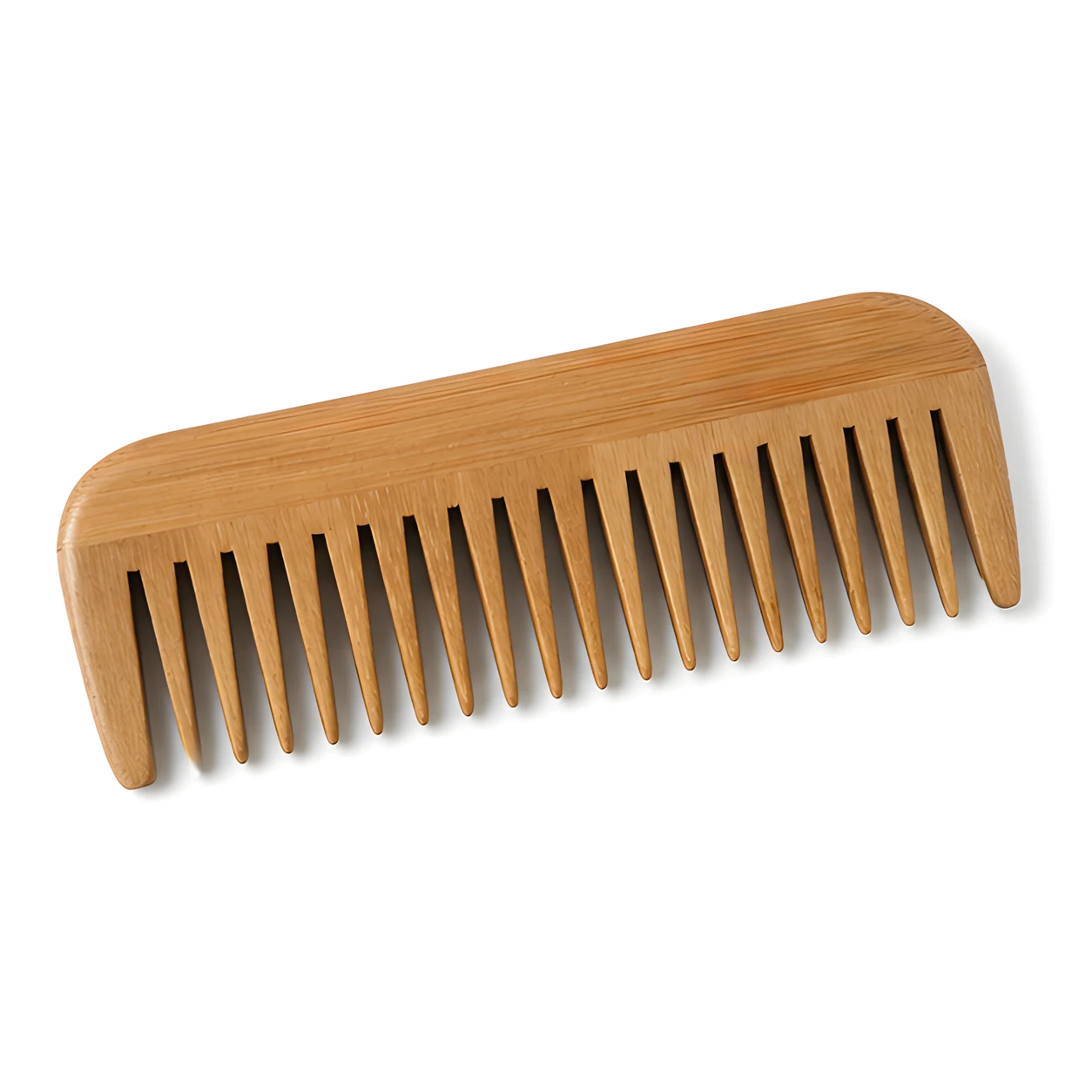
Bamboo is the default recommendation for most private-label and hotel programmes. WHY: it is hard, moisture-resistant, lightweight, biodegradable and naturally antistatic, and it photographs beautifully for packaging. TIPS: specify responsibly sourced material if you publish ESG claims; choose laser engraving for branding because it resists peeling in wet environments; and confirm the finish options available for your line on request, depending on whether you want a natural or glossy look. Our bamboo series spans hotel combs, wide-tooth combs, pocket combs, massage brushes and amenity sets.
Plastic combs: cheap, consistent, and harder to defend
Plastic remains the cheapest option and offers perfect dimensional consistency at high volume. WHY buyers stay: proven supply, lowest unit price, familiar packaging formats. WHY it is getting harder: single-use plastic audits at hotel groups, plastic taxes in several European markets, and guest perception in hospitality and beauty retail. TIPS: if your programme must keep a plastic line, specify recycled or bio-based polymer grades where your market permits, and be ready to document polymer sourcing during ESG audits.
Wood combs: the premium alternative
Wood combs occupy the premium tier between bamboo and luxury. WHY: deeper colour, warmer weight and a classic grooming heritage that suits gift sets and heritage brands. TIPS: wood requires slightly more care in finishing — specify food-safe wax or water-based lacquer — and confirm species documentation if you advertise the wood type. Our wood series is the choice for hotel VIP floors, anniversary gift sets and barbershop retail.

Cushion combs: when comfort beats tradition
Cushion combs and brushes pair a flexible rubber pad with a bamboo or wood body. WHY: the cushion follows the contour of the scalp, so massaging and detangling feel noticeably gentler; this is why spa and wellness brands stock them. TIPS: specify a removable, washable pad for hospitality disinfection routines; keep the body material consistent with your sustainability story; and use the large back surface for laser-engraved branding. Our cushioned series covers scalp massagers, paddle brushes and travel-sized versions.

Certifications that make a material claim defensible
A sustainability claim is only as strong as its documentation. Three document sets matter in this category: chain-of-custody documentation for bamboo and wood sourcing, documented consistent quality management, and social responsibility records across the production chain. Ask for copies before sampling, and check that the certificate number covers the finished comb, not just the raw material. VANTRE provides documentation on request and attaches inspection records to every shipment.
What ESG roadmaps mean for category managers
Category managers at hotel groups and retail chains are under pressure to cut single-use plastic, and grooming accessories are a quick win because natural alternatives already exist at scale. A typical 500-room hotel uses 50,000+ combs per year; switching that volume to biodegradable bamboo removes a measurable plastic stream — and it is one of the few swaps that guests actually notice and appreciate. In retail, the same logic feeds annual ESG reports and increasingly appears in shelf-sticker claims verified by FSC chain-of-custody numbers.
Biodegradability: what happens after the guest leaves
End-of-life behaviour is where the materials separate completely. A plastic comb persists in landfill effectively forever and sheds microplastics during degradation; a bamboo comb, especially with natural wax finish, breaks down in composting environments over a practical timeline. This difference matters for hotel groups calculating Scope 3 waste footprints and for retail brands facing extended producer responsibility rules. If your market requires disposal labelling, we can supply material documentation and waste-sorting guidance with the shipment.
Brand story: turning a comb into a talking point
A bamboo comb is one of the few amenities guests keep, photograph and mention in reviews. That makes it a low-cost marketing asset: engrave your logo on the handle, put a small sustainability note on the kraft sleeve, and the comb becomes a physical touchpoint that repeats your brand story after check-out or purchase. Plastic combs, by contrast, are rarely kept and never photographed. When you brief packaging designers, treat the comb as part of your campaign, not as a commodity line item.
Cost comparison: unit price versus total cost of ownership
The unit price gap between a bamboo comb and a comparable plastic comb is usually a few cents per piece — inside most buyers' price tolerance once branding and packaging are factored in. The honest total-cost picture favours bamboo even more: engraving on bamboo outlasts printed plastic labels, so reorder cycles and defect-driven reworks shrink. Our samples cost USD 1–10 per piece for existing models, refunded fully when your order reaches 10,000 pieces — a low-cost way to verify the numbers against your own cost model.
Supply chain: material availability and lead times
Because bamboo is a local, fast-cycle raw material, supply disruption risk is lower than for petrochemical inputs. Standard bamboo models carry an MOQ of 1,000 pieces; custom designs start at 5,000 pieces. Production takes 25–45 days (40–60 in peak season) at our factory, which runs 5,000,000 combs of annual capacity with 50+ employees across 12,000 m². Sea freight adds 30–35 days to the EU and 25–30 days to the US from FOB Ningbo.
Sampling: evaluate the material before you commit
Never switch a whole programme on a datasheet. Order samples of both materials in your target shapes and run your own evaluation: weigh them, wash them, leave one in a humid bathroom for a week, and hand one to your most critical customer. Compare tooth strength, surface finish and how the logo wears. Sample fees are USD 1–10 per piece for existing models and USD 50–100 for customised designs, fully refundable against bulk orders — the cheapest due diligence your brand can buy.
Private label: from material choice to logo
Once you have chosen bamboo, the private-label workflow is straightforward: select a base model from our hundreds of SKUs or develop a custom shape; approve the artwork proof within two working days; confirm the sample in 5–10 working days; then production runs 25–45 days. We support laser engraving, silkscreen, hot stamping and UV printing, plus packaging structures from kraft sleeves to rigid gift boxes. Your brand, your material claim and your packaging arrive in one shipment, inspected at every gate.
FAQ: bamboo vs plastic comb questions answered
Q: How long does a bamboo comb actually last? A: With normal use, several years. Moisture resistance, three sanding rounds and tooth-strength sampling keep the comb structurally sound far beyond the usable life of a plastic comb, which tends to deform or develop burrs first.
Q: Will bamboo combs look cheap on the shelf? A: No — the opposite. Raw or waxed bamboo with a laser-engraved logo reads as premium in hospitality and retail. What reads as cheap is a plastic comb with a printed logo. Packaging does the rest: kraft sleeves and paper boxes reinforce the natural story.
Q: Can we verify your bamboo claim in an audit? A: Yes. We hold internationally recognized certifications covering responsible material sourcing, quality management and social responsibility, including chain-of-custody documentation covering the finished comb. Inspection records accompany each shipment, and our factory in Langqiao welcomes scheduled audits by your quality and CSR teams.
Bamboo is among the fastest-growing plants on earth and needs no replanting — it is one of the fastest-renewing materials in grooming (INBAR).
Making the switch without disrupting your supply
Switching materials does not have to mean a risky big-bang change. Recommended path: run one property or one SKU line on bamboo first, with samples in hand and MOQ-level volume; collect guest or sell-through data for one quarter; then roll out across the programme while the plastic line covers any shortfall. Because standard bamboo models share our existing moulds and tooling, MOQ stays at 1,000 pieces and lead times stay in the standard window.
Ready to compare samples side by side?
You now have the four-dimension framework, the material-by-material breakdown and the switching playbook. The next step is evidence, not more reading: request a sample set with bamboo, plastic, wood and cushioned options in your target shapes, and evaluate them against your own priorities. Send us your product list and volumes — we will reply with a quotation within two working days and a sample plan matched to your timeline.