What the FSC label actually guarantees
FSC (Forest Stewardship Council) certification verifies that bamboo and wood are harvested from forests managed to environmental, social and economic standards. For manufacturers, the relevant credential is Chain of Custody certification: it tracks certified material from grove to finished comb, so every comb you receive can be traced back to a certified source. This guide explains what that paperwork really means for your purchasing decisions, your ESG reporting and the story you tell your customers.

Why bamboo: the fastest-growing raw material we use
Bamboo reaches full height in four to six years — versus decades for most hardwoods — and regenerates from the same root system after harvest, without replanting. That is why bamboo sits at the heart of our Bamboo series and why hotels and retailers choose it. Since VANTRE was founded in 2005, bamboo has been the workhorse of our production, and documented responsible groves now feed the majority of our Bamboo and Travel & Hotel series.
Why FSC certification still matters for bamboo
Fast growth does not automatically mean responsible management. FSC certification adds rules on water use, chemical treatment, soil protection, biodiversity and worker welfare — and it is independently audited, not self-declared. Buyers who assume bamboo is always green miss the point: the label is the proof, and without it a sustainability claim is just a claim.
How chain-of-custody certification works
Chain of Custody (CoC) is a bookkeeping system. Each batch of certified raw material carries a certificate-linked identifier from the grove; every handling step — purchasing, warehousing, cutting, sanding, finishing, packing — records how much certified input enters and leaves. At the end of the line, the factory can state exactly how much certified material went into a given order. This is why we can attach traceability to specific shipments rather than making a general green claim.
- Grove: bamboo harvested under responsible management standards
- Purchasing: material enters the factory with a certificate-linked identifier
- Production: documented input is tracked through cutting, sanding and finishing
- Shipment: each order is matched with its material records and certificate copy
The system runs on two accounting models. Under the percentage model, the factory tracks certified material as a share of its inventory and allocates the same share to outgoing orders. Under the credit model, every tonne of certified input earns credits that can be assigned to finished products. Both models produce the same result for you: a verifiable link between the bamboo in your combs and a certified grove, documented in numbers rather than adjectives.
What documentation you receive with each order
As a manufacturer with chain-of-custody documentation, VANTRE issues two documents per order on request: a copy of our valid certificate and a transaction record showing the certified material allocated to your shipment. Your compliance team files both directly. For recurring programs, we can also provide a consolidated annual statement that summarises certified volume delivered across the year — useful for your supplier sustainability review.
Why this matters for your compliance team
ESG reporting now asks suppliers for evidence, not promises. Social responsibility audits, quality management surveillance visits and your own customer questionnaires all request documented, verifiable inputs. A certificate copy with a valid CoC number turns a sustainability conversation into a fileable fact. Without it, your team spends weeks chasing declarations from suppliers who cannot back them up.
Think of the paperwork as insurance. When a customer questionnaire arrives with a two-week deadline, your compliance officer opens a folder containing certificate, transaction records and finish declarations, and answers in an afternoon. When that folder does not exist, the same question starts a sourcing project. The difference between the two scenarios is decided before the first purchase order, by supplier selection.
FSC in ESG reporting: turning claims into auditable facts
Scoring frameworks and procurement policies increasingly weigh supply-chain evidence. Responsibly sourced material contributes to environmental criteria; social responsibility audits cover the social pillar; documented quality management supports governance and quality. Taken together, the three create a documented story your ESG report can cite by name and number. Retailers preparing for disclosure regimes in the EU can attach our chain-of-custody records directly to their supplier files.
Disclosure rules in Europe now reach deep into physical supply chains, and bamboo is a raw material buyers must evidence. Our chain-of-custody records name the certificate, the licence number and the allocated volume per shipment, which is precisely the format auditors ask for. The same documents serve your annual sustainability statement, your social responsibility corrective-action log and your retail customer's supplier scorecard.

Standard pricing, no green premium at VANTRE
A common buyer fear is that documented material carries a green premium. It does not here: responsibly sourced bamboo is our standard inventory, purchased at scale from long-term grove partners, so the certificate costs you nothing extra. MOQs start from 1,000 pieces on existing models, and quoting follows the normal process — a quote within 2 working days, valid for 14 days, with samples refunded at bulk order milestones.
Beyond FSC: our wider sustainability stack
FSC covers raw material; the rest of the value chain needs its own controls. VANTRE combines responsible sourcing with documented quality management and social responsibility audits, and holds internationally recognized certifications covering responsible material sourcing, quality management and social responsibility as our operating baseline. One supplier, one audited system: that is the simplest way to keep your compliance workload low while your sustainability score rises.
Water-based finishes and natural wax: the details buyers miss
The finish is where many eco claims quietly break down. We use water-based finishes and natural wax across the production lines, avoiding solvent-heavy lacquers that would undermine a bamboo story. The same principle runs through our five series — Bamboo, Wood, Cushion, Travel & Hotel and Gift & Promotion — so a certified material is not wasted on a chemically coated product.
Packaging that completes the story
Packaging carries the sustainability claim to the end customer, so ours is designed from kraft and recycled paper, with minimal inserts and no unnecessary plastic. When your comb arrives in packaging your own eco-review can pass without asterisks, the sustainability story survives the unboxing moment — and so does the logo printed on it.
Factory operations: where sustainability meets scale
Sustainability claims are easy at small scale and hard at volume. Our plant covers 12,000 square metres with 50+ employees and an annual capacity of 5,000,000 combs, exporting worldwide. Every production line — cutting, sanding, finishing, packaging — runs under the same documented quality system, which is how a certificate becomes a repeatable process rather than a one-off gesture.
Hotels: building an eco-guest story with certified amenities
Hotel amenity programs are among the fastest adopters of certified materials, because guests now read the label. An responsibly sourced bamboo comb in the bathroom amenity set — paired with water-based finishes and kraft packaging — gives housekeeping a talking point and marketing a truthful claim. Our Travel & Hotel series combs are stocked specifically for this: certified material as standard, branded in-house with laser engraving or printed logos.
A typical hotel amenity set holds a comb, a toothbrush or shower cap and a soap dish — and the comb is often the only item guests keep as a memento. That gives it an outsize role in guest perception. An engraved responsibly sourced bamboo comb with the hotel crest is the item guests notice, keep and photograph; it is also the cheapest item in the set to make genuinely sustainable.
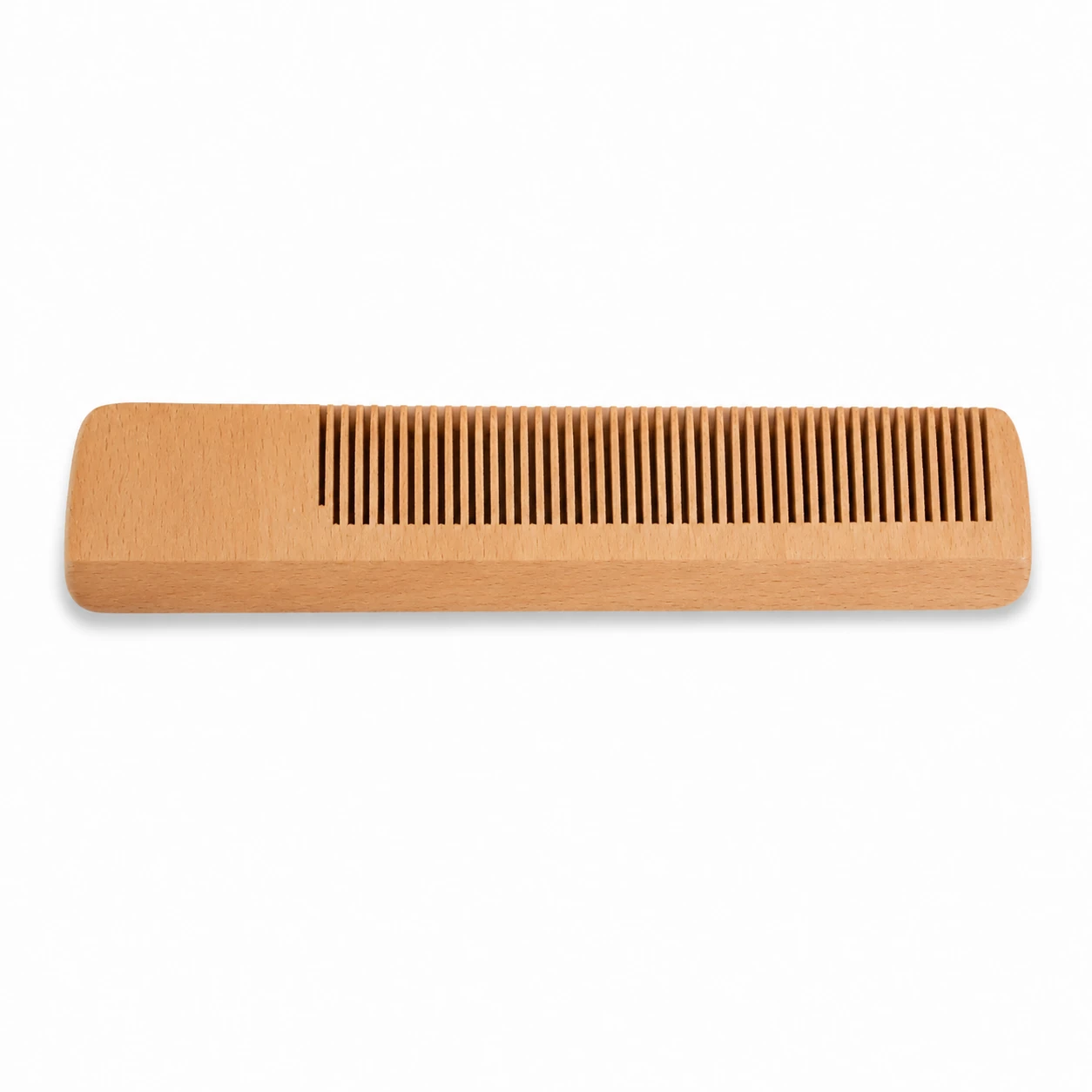
Retail brands: telling the FSC story to consumers
Consumers in major markets recognise the FSC tree-check logo on packaging, and retail buyers increasingly list it as a requirement. When you put our certified combs in your gift set, the packaging carries the mark and the SKU carries the documentation. The result is a claim your retail partners can verify from a file, not a slogan they must take on faith.
On-pack claims follow a simple rule: what you can prove, you may print. With certified material and a licence number in the file, your packaging copy can say certified bamboo without legal-review headaches, and your product page can repeat the claim in copy that carries weight with both search engines and shoppers.
Common misunderstandings about FSC bamboo
Three myths repeat in every buying conversation. First: bamboo is automatically sustainable. It is renewable, but responsible management is only guaranteed by certification. Second: certified material is always more expensive. At VANTRE it is standard inventory at standard pricing. Third: one certificate covers everything. CoC certificates are per-company and per-material-type, which is exactly why you should verify the supplier's own certificate rather than accepting a photocopy from a trading agent.
How to verify a supplier's FSC status
- Ask for the supplier's own certificate copy, not a third-party one
- Note the CoC licence number and check it against the FSC certificate database
- Confirm the certificate covers bamboo (and wood) materials, not only paper products
- Request a transaction record for your specific order, not a general statement
- Check the certificate's validity dates before your audit window closes
What to ask for in your next RFQ
Add five lines to your request for quotation: certificate copy with CoC licence number, confirmation that the order will be allocated documented, traceable material, a transaction record per shipment, packaging material declarations, and finish specifications (water-based, natural wax). Suppliers who answer with files, not promises, are the ones your compliance team can actually sign off.
Sample early: certificate copies take minutes, trust takes longer
Request the documents during sampling, not at delivery. Samples follow the standard flow — mockups in 2 working days, physical samples in 5–10 working days — and certificate copies can accompany them. That gives your team time to verify the licence number, prepare internal approval files and avoid a last-minute hold-up when the first container is already booked.
In 2026, sustainability is not a feature you add to a product — it is a document chain your supplier must prove.
FAQ: Does FSC certification raise my unit cost?
No. Responsibly sourced bamboo is standard inventory at VANTRE, purchased at scale from long-term grove partners, so there is no green premium on your unit price. MOQs start from 1,000 pieces on existing models; custom designs follow the standard 5,000 piece range. Quotes arrive within 2 working days and remain valid for 14 days.
FAQ: Can you provide FSC documents for every order?
Yes. As a manufacturer with chain-of-custody documentation we issue a certificate copy and a transaction record for each order on request, plus an annual consolidated statement for recurring programs. These files are accepted in social responsibility audits, quality management surveillance and customer compliance reviews, and they ship with your order documentation.
FAQ: Bamboo vs plastic — what is the real footprint?
Bamboo reaches full height in 4–6 years, regenerates without replanting and sequesters carbon while growing; plastic combs are derived from fossil feedstocks and persist in waste streams. Combined with water-based finishes, natural wax and kraft packaging, a certified bamboo comb carries a fraction of the lifetime footprint of a plastic equivalent — and the difference is now documented, not just claimed.