Four processes, four different brand impressions
The logo technique you choose changes not only the look of your comb but its price point, minimum order and durability. This guide compares the four processes we run in-house — laser engraving, screen printing, hot stamping and UV printing — so you can brief your design team correctly from day one. It is written for B2B buyers: importers, brand owners, hotel purchasing managers and gift programme coordinators who need a commercial answer, not just a pretty finish.
Step 1 — How to judge your branding needs
Before any artwork is prepared, decide what the logo must achieve. A hotel comb that disappears into a bathroom drawer needs a discreet, durable mark that survives years of daily use. A gift comb sold in a boutique needs a finish that photographs well and justifies the shelf price. A promotional comb for a trade show needs low cost and fast delivery. The same logo, engraved, printed or foiled, sends three different commercial messages.
Five questions to answer before you brief a factory
Take ten minutes with your product manager to answer these five questions. The answers decide the technique, the price and the schedule before a single file is sent.
- What is the primary surface — comb body, wooden handle, or packaging?
- Which wood or bamboo species will the logo sit on?
- Does the logo use brand colours, metallic tones, or a single-tone mark?
- What is your order quantity and target unit price?
- How quickly do you need sellable stock, and how soon will the logo change?
Send these answers together with your logo files, and the factory designers can move straight to a mockup without a clarification round. Buyers who skip this step routinely burn an extra sampling loop on artwork that was never going to work on a curved wooden surface.
Where your logo will live matters more than you think
Many brands assume the logo goes on the comb itself, yet for hotel and amenity programmes the packaging is often the larger canvas. A comb body offers roughly the space of a matchstick; a kraft box offers room for a full brand story. VANTRE's 20+ years of OEM work show the strongest programmes combine both: an engraved mark on the comb for permanence, a printed logo on the packaging for colour and storytelling.
Step 2 — The four processes we run in-house
All four techniques run on our own production lines inside one factory of 12,000 square metres. That matters for you because it means one supplier, one quality gate and one responsible contact, whether you are branding 1,000 pieces or a full container. Our five product series — Bamboo, Wood, Cushion, Travel & Hotel and Gift & Promotion — cover hundreds of models, all ready for any of the four finishes and backed by internationally recognized certifications covering responsible material sourcing, quality management and social responsibility.
Laser engraving: the natural choice for bamboo and light wood
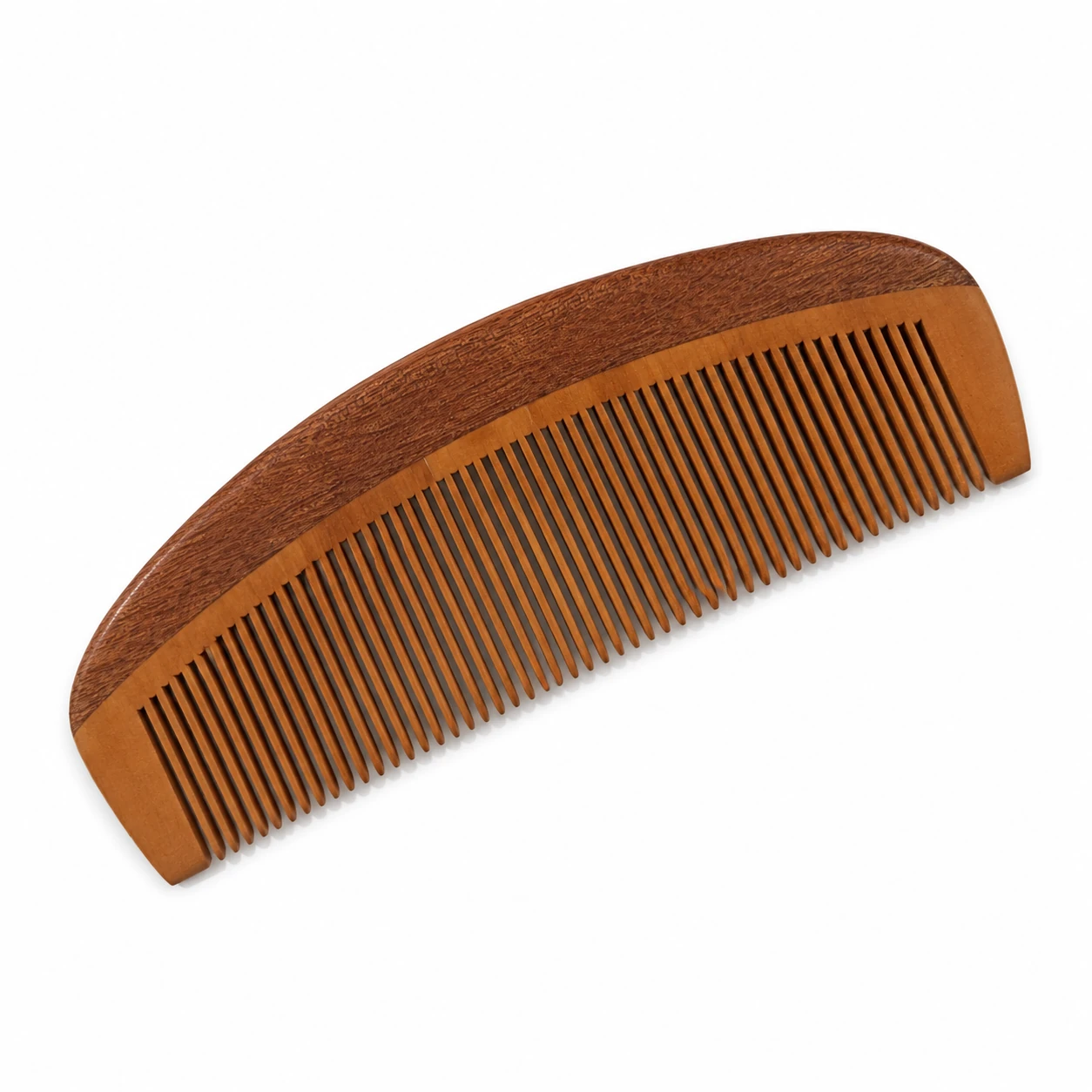
Laser engraving burns a fine, dark-brown imprint into the surface — permanent, food-safe and never peeling. It is the best match for bamboo, beech and pine, and it works at small MOQs, which makes it ideal for testing a new brand. Expect a digital mockup within 2 days and physical samples within 7. The engraved mark resists fading, scratching and washing off, which is why the majority of our hotel comb orders choose laser engraving.
- Best on: bamboo, beech, pine, light maple
- Result: natural dark-brown imprint, durable for years
- MOQ: from 1,000 pieces, ideal for brand trials
- File format: vector AI/CDR/SVG preferred, text outlined
- Added value: no ink and no plastic film, so the comb stays fully recyclable
Laser tips: line weight, contrast and grain
For engraved logos, avoid very fine lines — bamboo grain can close thin strokes. Keep a clear margin between the logo and the comb edge, and remember that laser colour is always a shade of brown: if your brand identity depends on a specific Pantone colour, engraving will not reproduce it. Design for contrast. A light wood shows the dark burn clearly, while dark sandalwood needs either a deeper power setting or a different technique altogether.
Screen printing: when your logo needs solid brand colours
If your logo uses brand colours, screen printing delivers them on kraft boxes, pouches and dark surfaces, with ink matched to Pantone references. It is the workhorse for packaging and for wooden handles where a solid, opaque colour must sit on top of the material. Screen printing suits larger quantities because the screen-making cost spreads across the run.
Screen printing tips: Pantone, mesh and placement
Send Pantone codes, not RGB guesses — the print must match your brand manual from the first carton. Keep colour areas inside the printable zone of the comb or box, and avoid details thinner than 1 mm, which can bridge during printing. Ask the supplier for a colour-approval sample before production; at VANTRE this is part of the standard sampling step, with physical samples typically shipped within 7 days.
Hot stamping: metallic foil for premium lines
Hot stamping presses a thin metal foil onto the surface under heat, producing a bright metallic mark in gold, silver, copper or custom shades. It suits sandalwood combs, premium gift boxes and hotel amenity programmes that want a five-star impression. The foil adheres firmly and resists everyday wear, which is why it appears on the top-end items of our Gift & Promotion series.
Hot stamping tips: foil colours and minimum detail
Foil reflects light, so fine script smaller than 1.5 mm blurs under heat and pressure. Keep the logo compact and bold, choose one foil colour per position to control cost, and remember that foil sits on the surface: combined with engraving it produces a raised, premium lockup. A flat mockup cannot show the metallic effect, so always review a physical sample before bulk production.
UV printing: the only process for photographic logos
UV printing cures ink instantly with ultraviolet light and reproduces full-colour gradients, photographic images and complex patterns on wood and bamboo. It is the only one of the four processes that can print a product shot or a lifestyle photo directly on the comb or box. For brands launching campaign series with seasonal artwork, UV printing keeps the design flexible between drops.
UV printing tips: underlay, borders and finish
On dark wood, request a white underlay so colours stay vivid; on light bamboo the underlay is optional. Keep a minimum 2 mm border from edges, and state matte or gloss in the artwork notes. UV ink is tough, but a clear-coat top layer adds protection for items that travel through customs and shelf life. Confirm the printable area of your chosen comb model on the product drawing before artwork is finalised.
The four processes side by side
| Process | Best result | Ideal surfaces | Typical MOQ | Sampling time |
|---|---|---|---|---|
| Laser engraving | Dark-brown permanent burn | Bamboo, beech, pine | From 1,000 pcs | Mockup 2 days, sample 7 days |
| Screen printing | Solid Pantone colours | Boxes, pouches, handles | From 500 pcs | Colour sample about 7 days |
| Hot stamping | Metallic foil | Sandalwood, gift boxes | From 500 pcs | Foil sample about 7 days |
| UV printing | Full-colour photographic | Light woods, boxes | From 1,000 pcs | Proof about 7 days |
Figures are typical for existing models; custom designs follow the standard OEM workflow with mockups in 2 working days and samples in 5-10 working days.
How wood species change the logo result
Bamboo and beech show laser engraving at its best: smooth grain, even burn, high contrast. Pine absorbs ink more deeply and suits screen printing. Maple and other light woods take UV printing with crisp colour. Dark woods such as sandalwood and walnut hide laser burns but frame gold foil beautifully. Match the species to the technique, and the same logo looks expensive on one material and muddy on another.
How comb shape affects logo placement
Comb bodies are curved, and the logo zone depends on the model: wide-tooth combs have a long flat spine, pocket combs have almost no free surface, and massage brushes offer the back of the cushion board. Your supplier should mark the safe zone on the model drawing. Choose a logo size that fits with a margin, and never stretch a square logo onto a long narrow spine — request a redrawn horizontal lockup instead.
Artwork requirements that save a full sampling round
Send vector files (AI, CDR, SVG or high-resolution PDF), convert all text to outlines and note Pantone codes. Name files clearly, include placement dimensions in millimetres and mark any mirrored or angled positions. If you have only a rough idea, our design team prepares free mockups from reference images before any sampling cost is committed.
- Vector AI/CDR/SVG or high-resolution PDF, text outlined
- Pantone codes for printed colours
- Logo zone dimensions in millimetres
- No hairline strokes for engraving, 1 mm minimum for printing
- Margin of at least 2 mm from comb edges
The cheapest branding mistake is a low-resolution logo — it costs you a full sampling round to discover.
MOQ, pricing and lead times: what changes per technique
Laser engraving starts at 1,000 pieces because the machine setup is digital and cheap; screen printing and hot stamping need screens and dies, so custom orders typically start around 5,000 pieces. Sampling: existing models cost USD 1–10 per piece, custom designs USD 50–100, fully refunded when the bulk order reaches 10,000 pieces. Quotes are issued within 2 working days with 14-day validity.
The timeline from artwork to your first carton
The ODM flow is: requirement review, then a concept or 3D mockup in 2 working days, sample confirmation in 5-10 working days, bulk production in 25-45 days (40-60 days in peak season), then quality inspection and shipment. Sea freight to the EU takes 30-35 days and to the US 25-30 days; express options via DHL, FedEx or UPS cover urgent reorders.
Combining techniques for a stronger brand story
The strongest programmes layer techniques: an engraved logo for permanence, foil on the box for the premium moment, a printed insert for the campaign message. Combinations cost more per unit, so reserve them for gift sets and premium hotel lines where the price point supports it. Ask for a comparison board — the same logo in all four finishes on the same model — before committing.
Branding your packaging: kraft boxes and pouches
Packaging carries colour, compliance text and the unboxing moment. Our standard packaging uses kraft and recycled materials that match the sustainable story of bamboo. Screen printing and hot stamping work on kraft boxes and paper pouches; a printed sleeve over a plain box is a low-cost way to rebrand between campaigns without changing the comb itself.
FAQ: How fast can I get a logo mockup and sample?
For an existing model, expect a digital mockup within 2 working days, then physical samples within 7 days. Free mockups are prepared from your reference images before sampling, so the only cost you risk is the sample itself. Most brands approve within one round, and we then lock the artwork into the production file.
FAQ: Can we switch techniques after sampling?
Yes — the artwork is the same vector file; the technique is a production parameter. Switching changes price, MOQ and lead time, so it is cheaper to request a comparison sample of two techniques at the same time. If you plan seasonal artwork, choose a technique that lets you change designs between campaigns without new tooling.
FAQ: Which technique is best for hotel or gift programmes?
Hotel amenity combs are almost always laser engraved: permanent, food-safe and inexpensive at volume. Gift programmes lean on hot stamping or UV printing for the premium unboxing moment. A hybrid — engraved comb, foiled box — delivers the strongest brand impression per dollar for high-end lines.